How to Start a Shuffleboard League (Court or Table)
Quick answer: to start a shuffleboard league, pick court or table shuffleboard, choose singles or doubles, set a game length that fits your time slot (court games to 75 points or a set number of frames, table games to 15 or 21), and run a round robin season of 7 to 12 weeks with a playoff at the end. With 8 teams and 4 courts or tables, everyone plays everyone once in 7 weeks, then a playoff week, a common season.
Shuffleboard is one of the easiest leagues to start because the equipment is usually already there: a court at the community center or a table in the bar. What it needs is a schedule people can count on, simple rules everyone has read, and standings someone keeps up to date.
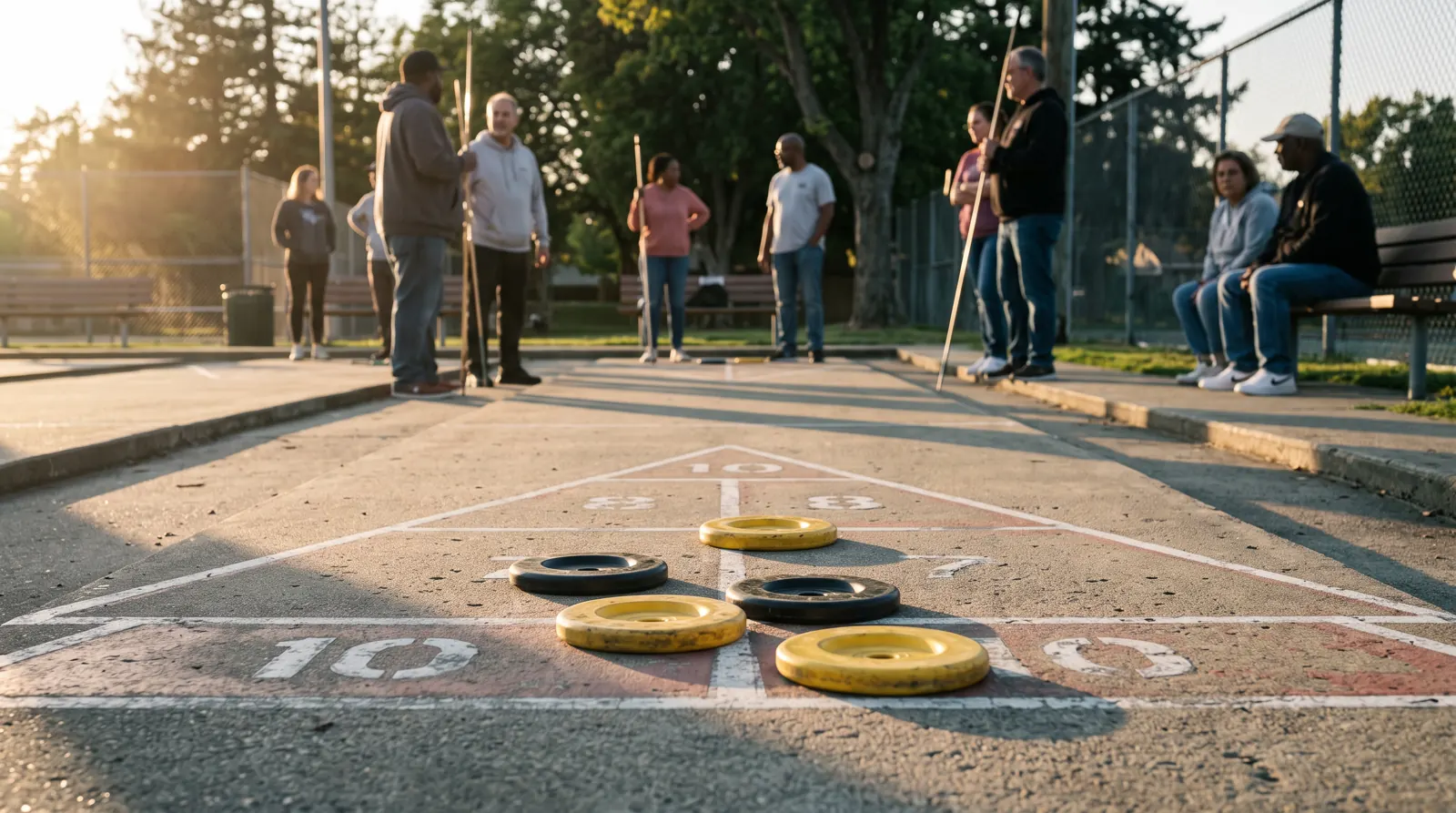
Court or Table: Two Different Games
The word "shuffleboard" covers two games, and your league rules should say which one you play.
| Court (deck) shuffleboard | Table shuffleboard | |
|---|---|---|
| Where | Clubs, parks, 55+ communities | Bars, breweries, game rooms |
| Equipment | Cues and 6-inch discs on a floor court | Weights slid by hand down a long table |
| Court or table | 39 ft between baselines, 6 ft wide (official) | 9 to 22 ft long; 22 ft for tournaments |
| Scoring | 10, 8 and 7, and 10-off (minus 10) | 1, 2 and 3, and 4 for a hanger |
| Game | To 75 points, or 8, 12 or 16 frames | To 15 or 21 points |
| Who scores | Both sides can score each frame | Only the side with the farthest weight |
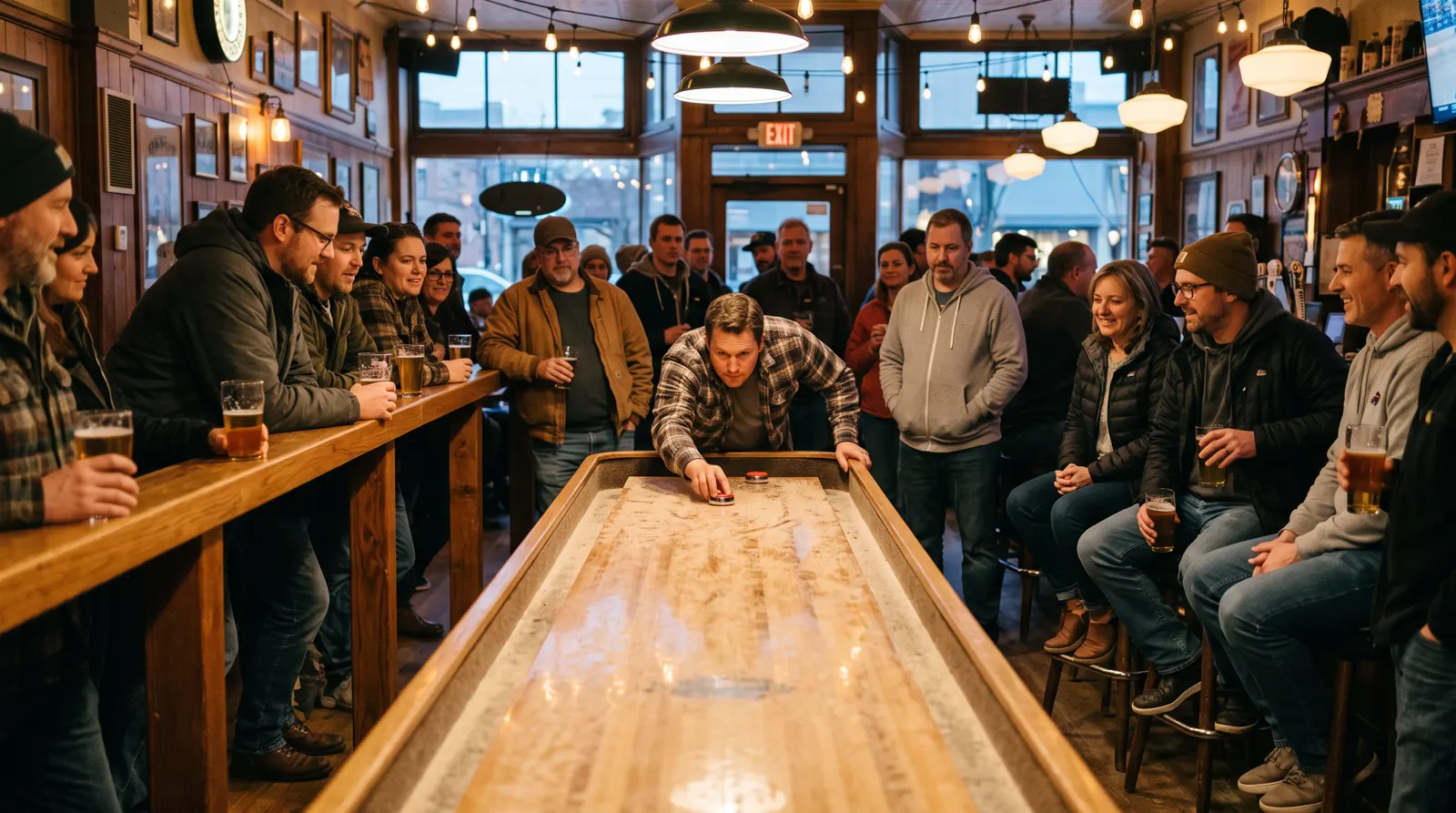
Court shuffleboard is the classic 55+ community game: low effort, played standing with a cue, and social, since players walk between ends and wait their turn. Table shuffleboard is the bar game: quick frames, a natural fit for teams of friends on a weeknight.
Choose Singles or Doubles
Doubles is the best default for most leagues. It fills courts faster, lets a newer player learn next to an experienced one, and a team can still play if one partner is away with a sub.
- Court shuffleboard doubles: partners play from opposite ends, one at the head and one at the foot, so nobody walks the length of the court.
- Table shuffleboard doubles: partners shoot from opposite ends of the table, the most common bar format.
- Singles works well for small clubs and for players who want a more competitive night.
- Draw nights: players sign up on their own and you draw partners each week. Good for communities where residents come and go.
Set a Game Length That Fits Your Time Slot
Choose the length of a game from the time you have, not the other way around.
- Court shuffleboard: a game to 75 can run long when the players are evenly matched. Many weekly leagues play a set number of frames instead, such as 8 or 12, so every game ends in about the same time and the next group can start. Time your first night and adjust.
- Table shuffleboard: a match of best 2 of 3 games to 15 is the common league night. If a table hosts several matches a night, play to 15, not 21.
Whatever you choose, put it in the rules before the season so nobody argues it on the night.
Build the Schedule
A round robin, where every team plays every other team once, is the fairest season. The math:
| Teams | Weeks for one round robin | Matches each week |
|---|---|---|
| 6 | 5 | 3 |
| 8 | 7 | 4 |
| 10 | 9 | 5 |
| 12 | 11 | 6 |
If you have fewer courts or tables than matches in a week, split the night into time slots: 8 teams on 2 courts play 4 matches in two slots. With an odd number of teams, one team has a bye each week. For more on rotations and byes, see how to create a round robin schedule, or print a free round robin schedule.
Communities with open play times often schedule into a window, such as 10 AM to 3 PM on Tuesdays and Thursdays, rather than one fixed start. That lets residents play around other activities and keeps courts busy all day.
Scoring and Standings
Agree on the scoring and tiebreakers before the first game:
- Who reports the score: both players, the home team captain, or a volunteer scorekeeper.
- Standings: rank by games or matches won, then head-to-head, then points scored minus points allowed.
- Table shuffleboard: record each game's score, such as 15-9, 12-15, 15-11, so points scored and allowed work as a tiebreaker.
- Court shuffleboard: a chalkboard or slider scoreboard at each court keeps the running score; the final score goes into the standings.
Write the Rules Down
Most league arguments come from rules that were never written: what counts as a hanger, whether a disc touching a line scores, and when a late team forfeits. Start with a template and change what doesn't fit:
- Court shuffleboard league rules for clubs and communities (discs, cues, 10-8-7 and 10-off scoring)
- Table shuffleboard league rules for bars and game rooms (weights, foul lines, hangers)
Both are free and fill in with your league's name, night and location. Outdoor courts also need a rainout policy.
End With a Playoff or Club Championship
Close the season with a playoff bracket for the top teams, or a club championship day open to everyone. Seed it from the standings so the season matters: first plays the lowest seed, and the top seeds get byes if the numbers don't come out even. How to seed a tournament bracket covers byes, and the free printable brackets work for a single night.
Running It in SportsGrove
In SportsGrove for shuffleboard, players and teams sign up online, and you number your courts or tables and pick days and start times (or a playing window), and the schedule is built with a court for every game and byes included. Players enter scores from their phones, standings update straight away, and you can print the schedule for members who prefer paper. Table shuffleboard matches are entered game by game. See SportsGrove for retirement communities and for bars and restaurants. Plans start at $29 a month with a 30-day free trial, no credit card.
Frequently asked questions
What is the difference between court and table shuffleboard?
Court (deck) shuffleboard is played on the floor or outdoors by pushing discs with a cue, scoring 10, 8, 7 or minus 10, usually to 75 points. Table shuffleboard is played by sliding weights by hand down a long table, scoring 1, 2, 3 or 4, usually to 15 or 21.
How many weeks should a shuffleboard league run?
Most leagues run 7 to 12 weeks. A round robin of 8 teams takes 7 weeks, and 7 weeks plus a playoff week is a common season.
Should a shuffleboard league be singles or doubles?
Doubles is the best default: it fills courts faster, pairs newer players with experienced ones, and a team can still play with a sub. Singles suits small clubs and competitive groups.
How long does a court shuffleboard game take?
It varies with how evenly the players are matched, which is why many weekly leagues play a set number of frames, such as 8 or 12, instead of a game to 75. Time the first night and adjust.
How do you keep standings in a shuffleboard league?
Rank by games or matches won, then head-to-head, then points scored minus points allowed. Record every game's score so the point tiebreakers work.
Ready to start your league?
SportsGrove handles registration, scheduling, payments and messages, so you can focus on running great game nights.
No credit card required · 30-day free trial