How to Seed a Tournament Bracket (with Byes and Pools)
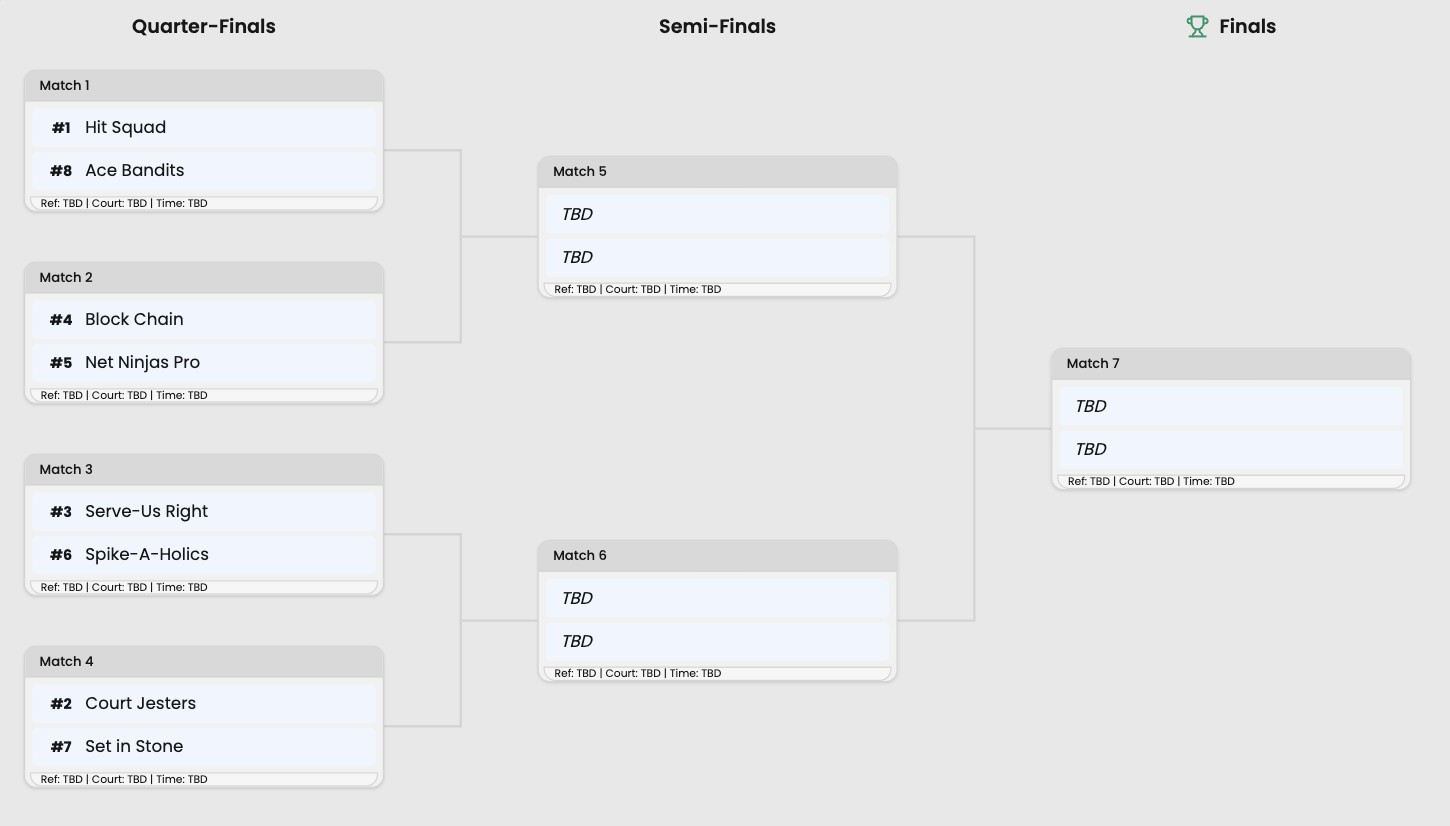
Quick answer: seed teams by strength (1 is the strongest), then place them so the top seeds can only meet in the late rounds. In an 8-team bracket the first round is 1 vs 8, 4 vs 5, 3 vs 6 and 2 vs 7. If your team count isn't 4, 8, 16 or 32, round up to the next one and give the extra spots to the top seeds as byes: 12 teams means a 16-team bracket with byes for seeds 1 to 4.
Seeding is what makes a bracket feel fair. Done well, the two best teams meet in the final; done badly, they knock each other out in the first round.
Rank the Teams First
Seed from the best information you have, in this order:
- Results this season: league standings or pool play records
- Ratings: DUPR for pickleball, a club rating, last season's finish
- Captain or director judgment for new teams
- A random draw when you truly know nothing
Write down your tiebreakers before the event. A common order is head-to-head result, then point differential, then points allowed, then a coin flip.
The Standard Seed Order
The rule: in every first-round match, the two seeds add up to the bracket size plus 1 (in an 8-team bracket, 1 + 8 = 9, 4 + 5 = 9). The order down the bracket keeps 1 and 2 on opposite halves, and 1, 2, 3 and 4 in different quarters.
| Bracket size | First-round matches, top to bottom |
|---|---|
| 4 teams | 1 vs 4, 2 vs 3 |
| 8 teams | 1 vs 8, 4 vs 5, 3 vs 6, 2 vs 7 |
| 16 teams | 1 vs 16, 8 vs 9, 5 vs 12, 4 vs 13, 6 vs 11, 3 vs 14, 7 vs 10, 2 vs 15 |
If everyone wins the matches they "should," the semifinals are 1 vs 4 and 2 vs 3, and the final is 1 vs 2.
Byes for Odd Team Counts
Brackets work in powers of 2: 4, 8, 16, 32, 64. When you have a number in between:
- Round up to the next bracket size.
- Byes = bracket size minus teams.
- Give the byes to the top seeds, in order.
| Teams | Bracket size | Byes | Who gets them |
|---|---|---|---|
| 6 | 8 | 2 | Seeds 1 and 2 |
| 10 | 16 | 6 | Seeds 1 to 6 |
| 12 | 16 | 4 | Seeds 1 to 4 |
| 20 | 32 | 12 | Seeds 1 to 12 |
A bye is a reward, so it always goes to the stronger team. Seeds 1 to 4 with byes go straight to the second round, where they play the winners of 8 vs 9, 5 vs 12 and so on.
Snake Seeding for Pools
When a tournament starts with pool play, spread the seeds across pools with a snake (also called serpentine) order so every pool gets one strong team and one weaker one. With 16 teams in 4 pools:
| Pool A | Pool B | Pool C | Pool D |
|---|---|---|---|
| 1 | 2 | 3 | 4 |
| 8 | 7 | 6 | 5 |
| 9 | 10 | 11 | 12 |
| 16 | 15 | 14 | 13 |
Read across the first row, back along the second, across the third. Each pool's seeds add up to the same total (34), so no pool is stacked.
Seeding the Bracket from Pool Play
After pools, rank the teams again by their pool results, then seed the bracket:
- Pool winners first, ordered by record, then point differential. Then second-place teams, then any lucky losers (the best records among teams that didn't finish high enough).
- Avoid rematches in the first round. Place teams from the same pool in different halves of the bracket when you can; a common way is crossing pools, so A1 plays B2 and B1 plays A2.
- Don't reseed during the bracket unless you announced it. Most rec tournaments keep the bracket fixed once play starts.
For how many teams to send to the bracket and how long it takes, see how many courts you need for a tournament. For choosing between formats, see single vs double elimination.
Seeding in SportsGrove
In SportsGrove, a playoff bracket is built from the league's final standings, so seeds come from results with your tiebreakers already applied. You can also set up a bracket before you know the teams and fill the seeds later. Tournament brackets seed from pool results, with lucky losers chosen by the next best record or a random draw. Teams & seeding lets you swap who sits in a seed spot without changing the bracket, auto-assign puts every round on your courts, and Print Bracket gives you a one-page copy for the wall.
Need a bracket on paper today? Download a free printable bracket for 3 to 64 teams, single or double elimination, with the seeds and byes already placed.
Frequently asked questions
How do you seed an 8-team bracket?
The first round is 1 vs 8, 4 vs 5, 3 vs 6 and 2 vs 7, top to bottom. Seeds 1 and 2 are on opposite halves, so they can only meet in the final.
Who gets a bye in a tournament bracket?
The top seeds. Round up to the next bracket size (8, 16, 32); the number of byes is the bracket size minus the number of teams, and they go to seeds 1, 2, 3 and so on.
How many byes do 12 teams need?
Four. Twelve teams use a 16-team bracket, and seeds 1 to 4 get first-round byes.
What is snake seeding?
A way to spread seeds across pools: seeds 1 to 4 go across pools A to D, 5 to 8 come back from D to A, and so on, so every pool has the same total strength.
How do you seed a bracket after pool play?
Rank pool winners by record and point differential, then second-place teams, then lucky losers, and place teams from the same pool on opposite halves to avoid first-round rematches.
Ready to start your league?
SportsGrove handles registration, scheduling, payments and messages, so you can focus on running great game nights.
No credit card required · 30-day free trial