How to Start a Pétanque League or Club
Quick answer: to start a pétanque league, mark out a few terrains on gravel or hard-packed ground (about 4 by 15 meters each, or 3 by 12 for casual play), choose doubles or triples, play games to 13 with a time limit if the night is short, and run a round robin season of 7 to 12 weeks ending in a club championship. Mêlée nights with drawn partners bring in players who don't have a team.
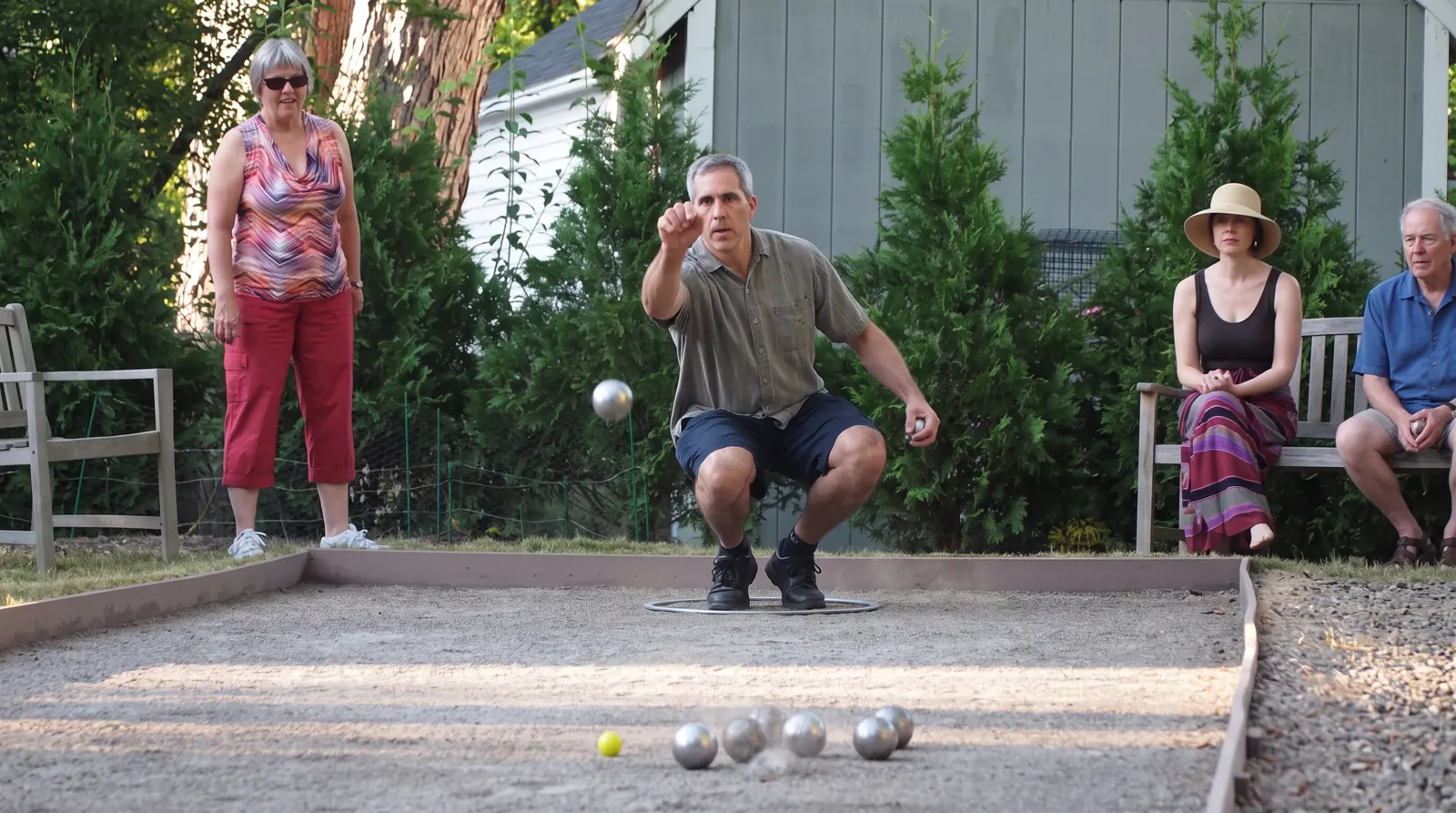
Pétanque is the French boules game: players stand in a small circle and throw hollow steel balls (boules) toward a small wooden target ball (the cochonnet, or jack). It needs no built court, plays well at any age, and is easy to learn in one evening, which is why it suits parks, 55+ communities, wineries and bar patios.
What You Need
- Terrain: any firm, level gravel or packed-dirt surface. Official rules call for at least 15 by 4 meters at national events and 12 by 3 meters at other events. A park path, a dirt lot or an old bocce court works for a league.
- Boules: each player needs their own set. Competition boules are 70.5 to 80 mm across and weigh 650 to 800 grams; leisure sets are fine for a rec league.
- A circle: drawn in the ground, 35 to 50 cm across, or a plastic ring.
- A tape measure for close calls, and string or chalk to mark terrains.
Choose Your Format
Pétanque has three standard formats:
| Format | Players per team | Boules each | Boules per side |
|---|---|---|---|
| Singles (tête-à-tête) | 1 | 3 | 3 |
| Doubles | 2 | 3 | 6 |
| Triples | 3 | 2 | 6 |
Doubles is the easiest league to fill, and triples is the classic club format. Many clubs run a regular triples or doubles league plus a mêlée night, where everyone signs up on their own and partners are drawn for the evening. Mêlée is the best way to bring in new players, since nobody has to find a team first.
How a Game Works
One team throws the cochonnet from the circle, 6 to 10 meters away. That team throws the first boule, trying to land closest. The other team then throws until it has the closest boule or runs out, and the teams keep going that way. When all boules are thrown, the team with the closest boule scores a point for each of its boules nearer than the other team's best. That's one end.
Games are played to 13 points. League and qualifying games may be played to 11 to save time. Each player has one minute to throw.
Set a Time Limit
A game to 13 can be over in 30 minutes or run well past an hour. For a league night with several rounds, set a cap:
- Time cap: for example 50 or 60 minutes per game.
- Extra ends: when time is called, finish the current end and play one or two more.
- Ties: if the score is level after the extra ends, play one more end.
Write the cap into the rules before the season. With a 1-hour cap, two or three rounds fit into an evening.
Build the Season Schedule
Run a round robin so every team plays every other team once:
| Teams | Rounds | Terrains needed for one round at once |
|---|---|---|
| 6 | 5 | 3 |
| 8 | 7 | 4 |
| 10 | 9 | 5 |
| 12 | 11 | 6 |
With two or three games a night, 8 teams finish a full round robin in 3 or 4 sessions, so many clubs play it twice over a season, or split into divisions by skill. Odd numbers give one team a bye each round. See how to create a round robin schedule, or print a free round robin schedule.
Standings and Tiebreakers
Every pétanque game has a final score, like 13-8, so point differential is a natural tiebreaker:
- Wins
- Head-to-head
- Points scored minus points allowed
- Points scored
Agree on who reports scores (both captains, or the winning team) and who measures close boules when the teams can't agree.
Write Down the House Rules
Start from the free pétanque league rules template, which covers all of the points below and fills in with your club's details.
Most clubs follow the international rules and add a short list of house rules:
- Format, game length and the time cap
- Terrain boundaries and what counts as a dead boule
- Who measures, and how a disputed measurement is settled
- How short a team can be and still play, and when a late team forfeits
- Weather calls for outdoor terrains (start from the free rainout policy template)
- A short code of conduct
End With a Club Championship
Most clubs end the season with a tournament (a concours): pools of 4 playing a round robin, then the top 2 from each pool into a single elimination bracket. With 12 terrains, 24 to 32 teams fit into one day. Use the tournament time calculator to check the finish time, and the free printable brackets for the knockout rounds.
Running It in SportsGrove
In SportsGrove for pétanque, teams register together and solo players sign up as free agents, so you can build teams or run a draw. Mark your terrains as courts, pick days and start times, and the round robin is built with a terrain for every game. Players enter scores like 13-9 from their phones, and standings update straight away with the tiebreakers you choose. Plans start at $29 a month with a 30-day free trial, no credit card.
Frequently asked questions
How big is a pétanque terrain?
Official rules call for at least 15 by 4 meters at national events and 12 by 3 meters at other events. For a rec league, any firm, level gravel or packed-dirt area about that size works.
How many players are on a pétanque team?
One, two or three. Singles and doubles players throw 3 boules each; triples players throw 2 each.
What score is a pétanque game played to?
13 points. League and qualifying games are sometimes played to 11 to save time.
How long does a pétanque game take?
From about 30 minutes to over an hour. Leagues often set a 50 or 60 minute cap, then finish the end and play one or two extra ends.
What is a mêlée in pétanque?
A night or tournament where players sign up on their own and partners are drawn at random. It is the easiest way for new players to join a club.
Ready to start your league?
SportsGrove handles registration, scheduling, payments and messages, so you can focus on running great game nights.
No credit card required · 30-day free trial